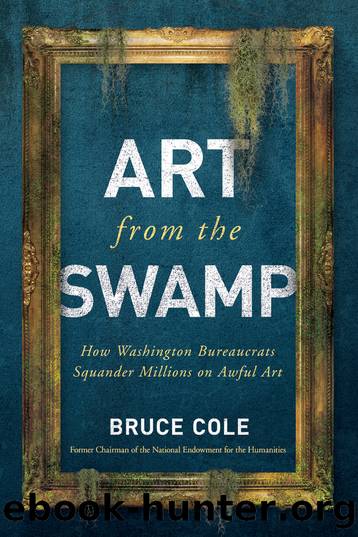
Art From the Swamp: How Washington Bureaucrats Squander Millions on Awful Art by Bruce Cole
Author:Bruce Cole [Cole, Bruce]
Language: eng
Format: epub
Tags: Art, Commentary & Opinion, Political Science, Business Aspects
ISBN: 9781594039973
Google: GfdADwAAQBAJ
Publisher: Encounter Books
Published: 2018-08-28T06:28:15+00:00
Buster Simpson explained that he wanted the artwork to reference the mission and work of the U.S. Army Corps of Engineers and respond to [the] siteâs location along the river . . . Buster Simpsonâs research efforts resulted in Oxbow Auger, a design concept for a kinetic artwork that combines ancient engineering tools with contemporary engineering innovationsâthe Archimedes screw (or water auger) and the helical wind rotor respectively. Buster Simpson explained that the wind-activated sculpture is intended to tap into the water table. Water from the ground will run through the screw-like portion of the sculpture and irrigate the detention pond in which the artwork will sit. The flow of water from the sculpture will depend on wind speed.51
Simpsonâs sculpture, then, was supposed to be a dynamic work of art, one that included interactions with wind, water, and vegetation. Although the panel noted some concerns with the engineering of the project, the panel nonetheless recommended that GSA move forward with the project. The final panel meeting took place on June 15, 2011, yet the memo from the regional commissioner to the chief architect recommending fabrication was not written until May 30, 2012, and, in that memo, the work of art is not named as Oxbow Auger but rather as Aerie. Crucially, however, there is no mention that the artistâs concept has changed; the regional commissionerâs memo provides no description of the artwork. One can only imagine the surprise of the panel members, then, when GSA unveiled a static pyramid made up of twenty 360-pound limestone spheres. Aerie is devoid of any integration with water, air, or vegetation; it looks as if Simpson consciously fabricated the antithesis of the final concept approved by the panel.
As these two examples show, the end products of Art in Architecture commissions can differ dramatically from the final concepts approved by the panels. This discovery again raises the question of why Art in Architecture panels are convened; if the panelâs role is, as weâve begun to see, almost entirely ceremonial, who benefits from the panelâs participation?
Site-Specific Art for a Nonexistent Site
It is fitting that this collection of case studies features an expensive, postmodern work of art created specifically for GSAâs headquarters; it would be shocking if GSA decorated its main offices in any other way. Unlike other recent Art in Architecture commissions, however, Jacob Hashimotoâs Kites (2013) exists in a liminal space, neither fully on display nor fully hidden from the public eye. As strange as it may sound, GSA chose to commission a site-specific work for a site that did not yet exist and, by the current looks of things, may never.
FIGURE 2.3 KITES, JACOB HASHIMOTO
Download
This site does not store any files on its server. We only index and link to content provided by other sites. Please contact the content providers to delete copyright contents if any and email us, we'll remove relevant links or contents immediately.
| Anthropology | Archaeology |
| Philosophy | Politics & Government |
| Social Sciences | Sociology |
| Women's Studies |
The Secret History by Donna Tartt(19086)
The Social Justice Warrior Handbook by Lisa De Pasquale(12190)
Thirteen Reasons Why by Jay Asher(8909)
This Is How You Lose Her by Junot Diaz(6886)
Weapons of Math Destruction by Cathy O'Neil(6279)
Zero to One by Peter Thiel(5801)
Beartown by Fredrik Backman(5754)
The Myth of the Strong Leader by Archie Brown(5507)
The Fire Next Time by James Baldwin(5442)
How Democracies Die by Steven Levitsky & Daniel Ziblatt(5218)
Promise Me, Dad by Joe Biden(5153)
Stone's Rules by Roger Stone(5087)
A Higher Loyalty: Truth, Lies, and Leadership by James Comey(4960)
100 Deadly Skills by Clint Emerson(4925)
Rise and Kill First by Ronen Bergman(4788)
Secrecy World by Jake Bernstein(4752)
The David Icke Guide to the Global Conspiracy (and how to end it) by David Icke(4717)
The Farm by Tom Rob Smith(4507)
The Doomsday Machine by Daniel Ellsberg(4490)
